Anisha Baid, Artist
Breaking the Screen is a video presentation exploring feminine frustrations with the computer interface using a collection of found clipart and stock images. The video is made in the style of corporate presentations that often talk about workplace ethics, sexual harassment and/or work-life balance and attempts to use those aesthetic and storytelling techniques to provoke a more complex consideration of gender politics in corporate spaces.

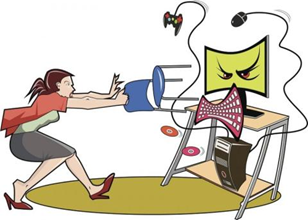
The project began with an extensive survey and collection of images available online as stock photographs and clipart depicting women interacting with computers. Amongst these images, which were largely situated in a corporate office, I began to take note of a recurring trope which showed the woman in distress before the computer. From the tags and keywords, I deduced that they were meant to depict a system failure of some kind that the woman could not overcome. However, removed from these contextual markers, these images are all unique representations of frustrated women and present a varying range of emotion and physical aggression in each figure. They are partly interesting because of the lack of pictorial depictions of angry or frustrated women in contemporary visual culture, and as the collection grew, I began to sense a potential energy in each image – a precipice building within the character frozen in a moment anxiety or frenzy. Some of the women in these pictures looked hysterical, the kind of hyperbolic aggression that one could not imagine being caused by a malfunctioning machine.

Unlike editorial or journalistic stock images, commercial stock images are fictive, staged scenes of essentially “sellable” scenarios. As a methodology for image-making, stock photography is always in a complex negotiation with social realities; in his paper “Inside the Image Factory”, Paul Frosh (2001) refers to this as a ‘systematic and selective re-description of reality’. This re-description is essentially based on the norms and societal values defined by global capitalism, and the stock photography industry has evolved with the trends and needs of the advertising industry. As such, they have moved away from representing actual products and simple situations in which they might be applicable, to representing more complex, ambiguous and aspirational ideas like health, freedom, patriotism, etc. In doing so, stock photographers are presented with the nuanced and volatile task of assumption – creating pictorial averages of contemporary experience which might apply to the broadest range of marketing scenarios while also maintaining a quality of visual interest.
In this sense, ambiguity is at the very heart of the practice of stock photography – meaning is not linear and every image can potentially generate a large range of interpretations. However, this practice is also very effective in conveying specific meanings to diverse populations/consumers; for example pictures of a smiling, heteronormative family convey a sense of “health and wealth” which most people understand immediately when looking at an advertisement for life insurance. Stock images simultaneously refer to and generate contemporary visual culture in which meaning is manufactured intertextually, i.e. within a network of other images, graphic elements and text. This also explains why one often encounters countless “versions” of the same image on stock photography archives – once established as a marketable reality, a trope is regenerated until its meanings are exhausted or made redundant by the same media industries that create it.


My own practice of collecting stock images was driven by the same underlying desire to tell stories – or rather in this case, to generate a history for these images that were otherwise removed from any specific space, time or context. What each of these images appeared to contain was a ‘tiny spark of contingency’ visible in the particular forms taken by each iteration of the trope. Walter Benjamin refers to this ‘tiny spark’ in photography which he describes as an aura of the past that makes itself visible in the fixed image being viewed in the present. It is hard to define the content of these auras which appear to leak out of the otherwise commercial imagery. Some, in their drawings of a disappointed face evoked for me the likeness of my mother’s disappointed face while others, in their anger and aggression seemed to evoke a madness and trauma I had witnessed in complex female characters in cinema and television. These meanings I was generating were not universally inscribed into each image, but the act of bringing them together along with other elements brought these potentialities to life.
Along with the images themselves, I also appropriated the larger framework and form of the corporate presentation within which these images are often shared, accompanied by provocative and vague language as well as minimal graphic design elements. The presentation was designed using the popular design website canva.com, which has come to define the present corporate aesthetic landscape. The final form of the work has come to reflect the ambiguous but uplifting messaging that permeates advertising and corporate culture. It takes an image – a low quality, watermarked stock photograph as its main character, and traces her fictional journey to high resolution freedom. As the narrative progresses and the images are allowed to speak for themselves, the dysfunctional computers reveal themselves as metaphors for a larger frustration and the broken computer screen becomes a receiving surface for a collective anger which is only expressed through the repressive social structures when it is veiled as something else.